Newborn Screening in Ajmer: Tests Your Baby Needs
Dr. Mayur Kumar Goyal
Published on November 15, 2026
Newborn Screening in Ajmer: Tests Your Baby Needs
Your baby looks perfectly healthy, so why test anything? Because some serious conditions show no signs at birth, and a few drops of blood and a quick hearing check can find them while they are still easy to treat. Here is what a newborn screening hospital in Ajmer checks, when to go, and what the results mean.
What is newborn screening?
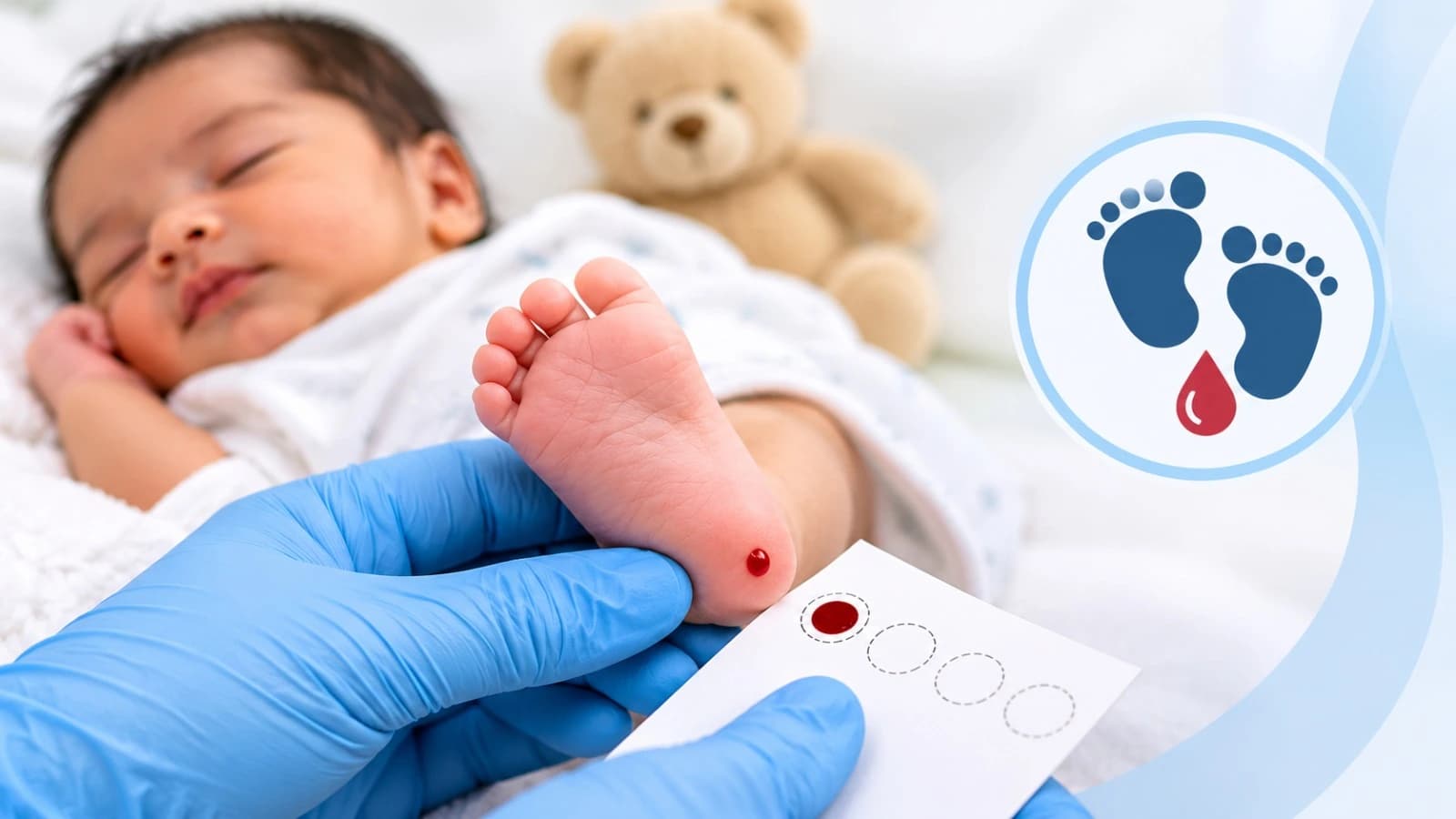
Newborn screening is a group of simple tests done in the first few days of life to catch hidden but treatable conditions before they cause harm. It covers a heel prick blood test for hormone and metabolic disorders, a hearing test, a pulse oximetry check for heart defects, and a head-to-toe examination.
Screening does not diagnose a disease. It sorts babies into “looks fine” and “needs a closer look,” so the few who need treatment get it early.
Why does newborn screening matter if my baby looks healthy?
Most conditions found by screening look completely normal at birth. Congenital hypothyroidism is the best example. A baby born without enough thyroid hormone feeds, sleeps and cries like any other baby, but untreated, the condition can permanently affect brain development. It is one of the most common preventable causes of intellectual disability, and the treatment is a daily tablet.
Which tests are included in newborn screening?
A complete newborn screening check in Ajmer usually includes five parts:
| Test | What it looks for | How it is done | When |
|---|---|---|---|
| Heel prick blood test | Congenital hypothyroidism, CAH, G6PD deficiency; extended panels add PKU, galactosemia and other metabolic disorders | A few drops of blood from the heel on a filter-paper card | 24 to 72 hours after birth |
| Hearing screen (OAE) | Hearing loss present from birth | Soft probe in the ear while the baby sleeps | Before discharge or in the first weeks |
| Pulse oximetry | Critical congenital heart disease | Light sensor on the hand and foot | After 24 hours of age |
| Eye check | Cataract and other eye problems; ROP in premature babies | Red reflex check with a light; eye specialist exam for preterm babies | At birth check-up; ROP exam in the first weeks |
| Physical exam | Hip problems, club foot, cleft palate, heart murmurs and other birth defects | Head-to-toe check by the paediatrician | Within the first days |
The heel prick panel
The Indian Academy of Pediatrics (IAP) recommends a basic three-test panel: TSH for congenital hypothyroidism, 17-OHP for congenital adrenal hyperplasia (CAH), and G6PD for G6PD deficiency. Extended panels use tandem mass spectrometry to check dozens of metabolic disorders from the same blood spot. Ask your doctor which panel fits your family history.
The hearing test
The otoacoustic emission (OAE) test takes a few minutes and does not hurt. If a baby does not pass, a more detailed test called BERA is done. The international “1-3-6” goal is to screen by 1 month, confirm by 3 months and start support by 6 months, because speech develops fastest in the first year.
When should your baby have newborn screening?
The heel prick test should be done between 24 and 72 hours after birth, once your baby has started feeding. Testing earlier can miss some conditions, because certain markers only rise after the baby has had milk for a day or so.
This is where many families slip up. Normal deliveries in Ajmer are often discharged within a day, before the ideal window opens. If that happens, don’t skip the test. Bring your baby back on day 2 or 3, or ask the hospital to arrange the sample before you leave.
Premature babies need extra attention. National guidelines in India advise an eye examination for retinopathy of prematurity (ROP) for babies born before 34 weeks or weighing under 2 kg. The heel prick test may also need repeating.
What happens if a screening result is abnormal?
An abnormal newborn screening result means your baby needs a confirmatory test, not that your baby has a disease. Many “positive” screens are false alarms, caused by prematurity, early sampling or a stressful birth. The doctor will call you back for a repeat or more specific test.
Do answer that call quickly. For congenital hypothyroidism and CAH, treatment works best when it starts in the first two weeks of life.
- Your doctor explains the result and what it might mean
- A confirmatory blood test or specialist test is done
- If the condition is confirmed, treatment starts and a follow-up plan is set
- If the test is normal, routine baby care simply continues
Common mistakes parents make with newborn screening
- Skipping it because the baby “looks fine.” The conditions screened for are, by definition, hidden at birth.
- Testing too early. A sample taken in the first 24 hours can miss some disorders.
- Missing the hearing re-test. A “refer” result on the first OAE is common and often clears, but only a repeat test can tell.
- Ignoring a recall call. A delayed confirmatory test can mean delayed treatment.
Frequently asked questions
What is newborn screening?
Newborn screening is a set of simple tests done in the first days of life to find serious but treatable conditions before symptoms appear. It usually includes a heel prick blood test, a hearing test, a pulse oximetry check for heart defects and a physical examination.
When should the newborn heel prick test be done?
The heel prick blood test is ideally done between 24 and 72 hours after birth, once the baby has started feeding. A sample taken in the first 24 hours can miss some conditions, so the test may need to be repeated.
Is newborn screening painful for my baby?
The heel prick causes a brief sting and most babies settle within a minute, especially if they are fed or held skin-to-skin during the test. The hearing test and pulse oximetry are painless and are usually done while the baby sleeps.
Does an abnormal newborn screening result mean my baby is sick?
No. An abnormal screening result means the baby needs a confirmatory test, not that a disease has been diagnosed. Many babies with a positive screen turn out to be healthy, but the follow-up test should be done quickly.
Where can I get newborn screening done in Ajmer?
Mayur Children Hospital in Vaishali Nagar, Ajmer, offers newborn check-ups and screening under Dr. Mayur Kumar Goyal, a paediatrician with an IAP fellowship in neonatology.